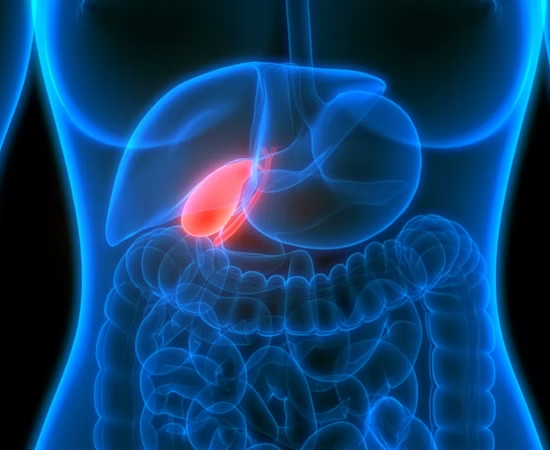
WHAT IS THE GALLBLADDER?
Your gallbladder is a small organ in your upper abdomen.
WHAT DOES THE GALLBLADDER DO?
The gallbladder collects and stores a secretion called bile that helps your body break down food. Small, hard deposits called gallstones can form in the gallbladder. This is a common condition. If your gallstones cause health problems, doctors might do surgery to remove it. For example, you might need surgery if your gallbladder is no longer working correctly and you have pain. Your doctor will talk with you about this.
In the past, doctors made a large cut (incision) in the belly to remove the gallbladder. This is called open surgery. Today, doctors can do this surgery with tiny instruments and just a few small cuts. This is called laparoscopic surgery, because the main instrument is called a laparoscope .Minimally invasive surgery is a general term for surgery with these small instruments.
What Causes Gallbladder Problems?
Gallstones are often the cause. These small, hard deposits form in the gallbladder. They can also get into the bile duct, which connects the gallbladder with your intestines.
You are more likely to get gallstones if you:
- Are a woman,
- Have had children,
- Are overweight, or
- Are over 40.
You might also get gallstones if other people in your family had them. Doctors do not have a consistent way of preventing gallstones.
What are the symptoms of gallbladder problems?
Symptoms can include:
- pain in your abdomen,
- Nausea
- vomiting,
- Indigestion,
- Fever, and
- Yellow skin – Jaundice is the medical term for skin and eyes that look yellow. You might get jaundice if gallstones block your bile duct.
How do doctors diagnose gallbladder problems?
Your doctor will probably order a test called an ultrasound. It shows the inside of the body using sound waves. You are awake during the test, and it does not hurt.
If you need more tests, you might have a CT scan or a test called a HIDA scan. The HIDA scan uses an injection of dye to show how well your gallbladder and bile duct are working.
How do doctors treat gallbladder problems?
Taking the gallbladder out is usually the best way to treat gallbladder problems. You might get some relief from changing your diet. For example, eating less fat can help. But gallstones rarely go away on their own.
You might have heard about treatments to break up gallstones or make them melt away (dissolve). Unfortunately, these do not usually work well.
What are the advantages of laparoscopic gallbladder surgery?
- Smaller incision – Several small incisions, each less than one (1) inch long, instead of a 5- to 7-inch incision for open surgery.
- Less pain than after open surgery.
- Quicker recovery than open surgery – You might go home the same day you have your surgery. You can also go back to regular activities more quickly.
How is Laparoscopic Gallbladder Removal Done?
You will have general anesthesia for your laparoscopic gallbladder removal. This means you are asleep during surgery. When surgery is finished, the surgeon closes your incisions with tiny stitches, staples, surgical tape or glue. These disappear as you heal, so the doctor does not need to remove them later.
Once you are asleep, the surgeon makes an incision near your belly button and inserts a small device called a port. The port creates an opening that your surgeon can use to fill the abdomen with gas. This creates space to do the operation. Next, they insert a small camera through the port. The camera shows the surgery on a screen in the operating room. Once the surgeon can see clearly, they put in more ports to insert long, narrow instruments. Finally, they gently disconnect your gallbladder and take it out through one of the incisions. Most operations need 3 or 4 incisions, but some have more.
What if I Cannot Have Laparoscopic Gallbladder Removal?
A few people cannot have laparoscopic gallbladder removal. You might have open surgery if you are one of these people. Some reasons for having or switching to open surgery are:
- Your gallbladder has a lot of damage – Such as scars or inflammation.
- You have scar tissue in your abdomen from earlier surgery.
- You have obesity – This means being very overweight.
- The surgeon cannot see very well inside your body through the laparoscope.
- You have bleeding problems during surgery.
It is not a complication (problem) if your surgeon decides to switch to open surgery. They will switch if open surgery is the safest option for you. Your surgeon might not know this until after the laparoscopy starts. They will use their best judgment about the safest surgery for you.
What are the Possible Complications of Laparoscopic Gallbladder Removal?
You will probably go back to normal activities within one week. Complications are problems that happen during medical care or after it. Most people who have laparoscopic gallbladder removal have few complications or none at all.. They can include bleeding, infection in the surgery area, hernias, blood clots, and heart problems. A hernia is when a small amount of your gut (intestine) or other tissue bulges through the muscles that cover it.Gallbladder surgery could hurt nearby areas such as the common bile duct, large intestine (colon), or small intestine. It is also possible that bile might leak into the abdomen after gallbladder surgery.
What to Expect After Surgery
WHAT SHOULD I EXPECT AFTER GALLBLADDER REMOVAL SURGERY (CHOLECYSTECTOMY)?
GOING HOME
You can probably go home the day you have your surgery, or you might stay in the hospital overnight. You need to be able to drink liquids before you go home.
WILL I BE IN PAIN?
You will feel some pain after surgery. Pain at the incision sites and in your abdomen is common. You might also have pain in your shoulders. This is from the air put into your abdomen during the operation. The shoulder pain should go away in 24 to 48 hours.
You can probably go back to normal activity about a week after laparoscopic gallbladder removal.If you do a physical job with heavy lifting, ask your doctor when you can go back to work. You can drive 24 hours after you had anesthesia if you are not taking narcotic pain medicines.
If you had an open surgery with a large incision, you need more time to recover. You will probably need to stay in the hospital for a few days after surgery. Expect to go back to full activities in 4 to 6 weeks. You will probably recover more slowly in other ways, too. Your doctor can tell you what to expect.
WHEN TO SEE YOUR DOCTOR AFTER SURGERY
You need to see your surgeon 2 to 3 weeks after surgery.